
For the commercial oil-analysis lab that needs hundreds of kinematic-viscosity measurements per shift, run unattended overnight, with on-line PCS validation and the right tube selected automatically for every sample.
A Houillon viscometer is a capillary-tube viscometer geometry, originally developed in France, optimized for automated kinematic-viscosity measurement at 40°C and 100°C. A precise volume of sample falls through a narrow-bore glass capillary under gravity at controlled temperature; the time to fall between two optical sensors, multiplied by the tube’s calibrated factor, gives the kinematic viscosity in cSt (mm²/s). The same tube can be used over a defined viscosity range; tubes with different factors cover the rest.
The robotic automation layer — what CINRG’s CS-HVA adds — takes the Houillon baths (ISL/PAC viscometer baths in current installations) and surrounds them with an XYZ robot, a syringe pump, a wash station, automated solvent filling, and fuzzy-logic tube selection. Together, they convert what was previously a labor-intensive sequence of operator decisions into an unattended overnight run.
The relevant standard is ASTM D7279-14, “Standard Test Method for Kinematic Viscosity of Transparent and Opaque Liquids by Automated Houillon Viscometer.” D7279 is the modern alternative to the older ASTM D445 (manual U-tube capillary viscometry) for high-throughput laboratory use. The two methods produce equivalent kinematic-viscosity values; D7279 is significantly faster per sample and supports unattended operation.
Each sample passes through this sequence inside the instrument:
Process-control standards (PCS) interleave automatically through the run. Each tube can be configured with up to 2 PCS; the 4-bath system supports up to 16 PCS in total. If a PCS measurement falls outside its configured upper or lower threshold, the tube is automatically locked out of service, prior samples on that tube are quarantined to a fail directory, and the remaining tubes continue running unaffected.
The decision is driven by dwell time, not volume.
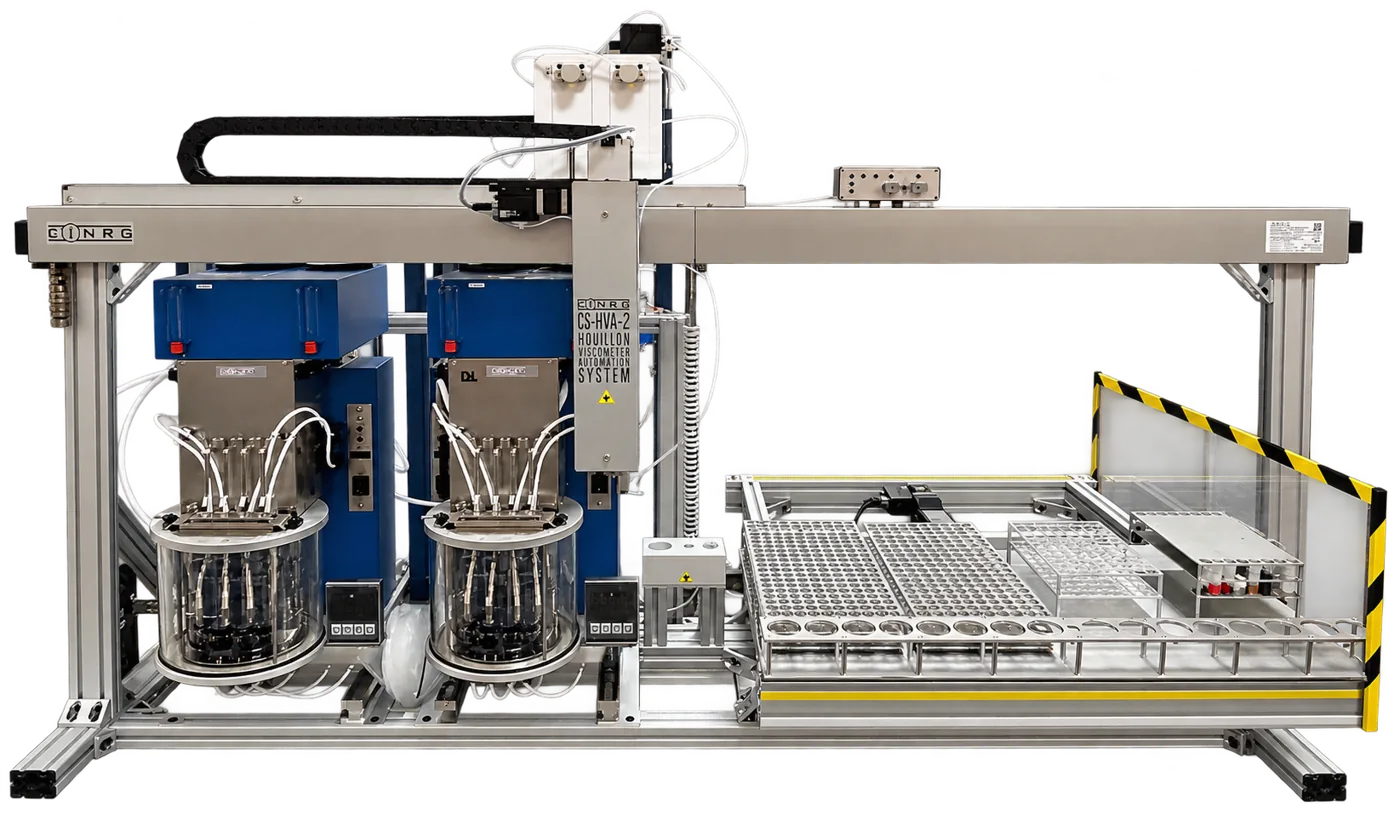 CS-HVA-2 (2-bath) CS-HVA-2 (2-bath) |
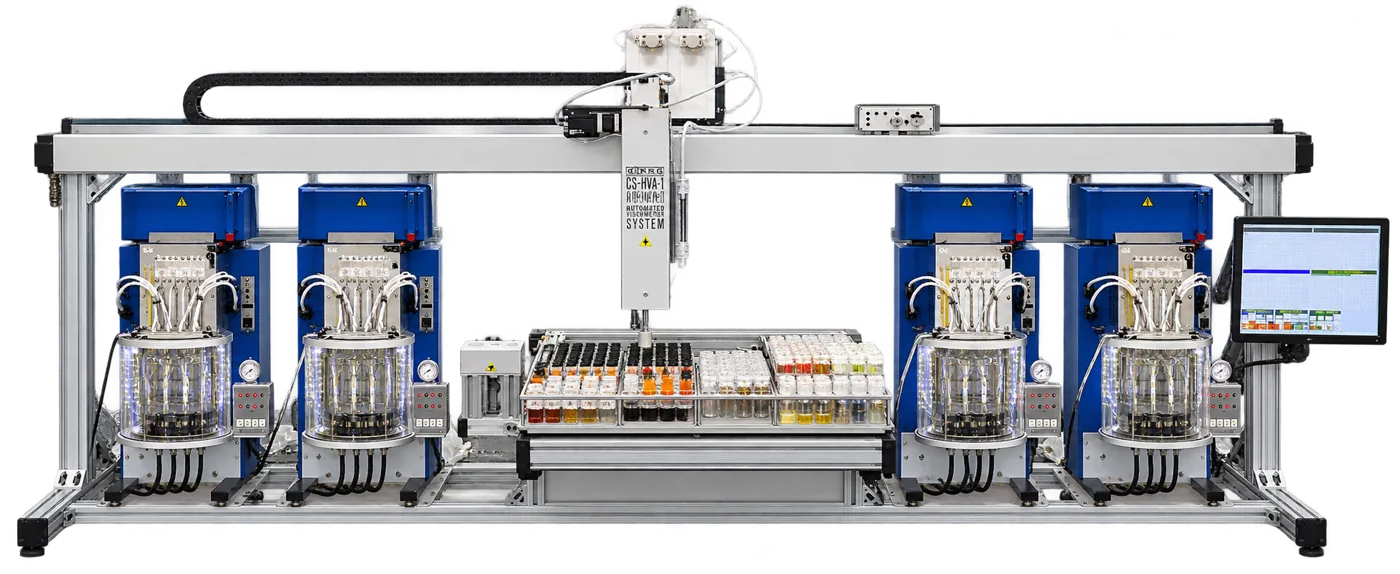 CS-HVA-4 (4-bath) CS-HVA-4 (4-bath) |
|
|---|---|---|
| Bath count | 2 | 4 |
| Typical temperature setup | 1 × 40°C, 1 × 100°C | 2 × 40°C, 2 × 100°C |
| Dwell time in tube | 8–15 s | 30–90 s (strict ASTM D7279) |
| Sample throughput | 800–1,000 measurements / 8-hr shift | 1,000–1,200 measurements / 8-hr shift |
| Sample table | Customizable on both: 4 × 200- or 100-position trays, 4 × 96-position PerkinElmer trays, or standard lab racks | |
| PCS configuration | Up to 8 (2 per tube × 4 tubes typical) | Up to 16 (2 per tube × 8 tubes typical) |
| Footprint | ~7 ft / 214 cm wide | ~10 ft / 320 cm wide |
| Weight | ~300 lb / 136 kg | ~500 lb / 226 kg |
| Right for | Methods using short 8–15 s dwell times | Labs following strict ASTM D7279 30–90 s dwell times |
Both configurations share the same software, same fuzzy-logic tube assignment, same wash station, same multi-point calibration support, and the same ISO/IEC 17025 validation track record. The choice is run time, not capability. If your method uses short 8–15 s dwell times, the CS-HVA-2 delivers 800–1,000 measurements per shift. If you follow strict ASTM 30–90 s dwell times, the CS-HVA-4’s extra baths run in parallel to deliver 1,000–1,200 per shift despite the longer runs.
“The CINRG robotic viscometer system has improved repeatability of viscosity results and freed up close to one full day of technician time. A definite win-win for our laboratory.”Frank PerriWearCheck Canada, Toronto
“After two months working with the CS-HVA-1 we think it is, by far, the biggest advance in automation we have in our labs. We are fully satisfied with its performance and results.”Jose IgnacioTekniker, ISO/IEC 17025-accredited testing laboratory
“CINRG CS-HVA validation runs against Conostan certified standards produced internal-standard sample populations of n=196 with measured KV40 and KV100 values consistently inside the ±2% certified bounds.”CINRG technical validationData available on request as basis for customer-side ISO 17025 method validation
A Houillon viscometer is a capillary-tube viscometer designed for kinematic-viscosity measurement at 40°C and 100°C. A robotic Houillon viscometer adds an XYZ robot, syringe pump, and wash station that automate the sample handling — letting the lab run hundreds of samples per shift unattended under ASTM D7279-14.
ASTM D7279-14 is the Standard Test Method for Kinematic Viscosity of Transparent and Opaque Liquids by Automated Houillon Viscometer. It defines the operation of automated Houillon-type capillary viscometers at 40°C and 100°C and is the modern alternative to ASTM D445 (manual U-tube capillary) for high-throughput lab use. The two methods produce equivalent kinematic-viscosity values.
A 2-bath CS-HVA-2 delivers 800–1,000 viscosity measurements per 8-hour shift and suits methods using short 8–15 s dwell times. A 4-bath CS-HVA-4 delivers 1,000–1,200 measurements per shift and suits labs following strict ASTM D7279 30–90 s dwell times. Both run unattended overnight with auto-solvent filling and idle-timeout pump shutdown.
Each sample in the batch file carries an expected viscosity at 40°C and 100°C. The CS-HVA software assigns the sample to the correct viscometer tube factor automatically. If the right-factor tube is busy, the system queues the sample. If no suitable tube is currently in service, the sample is skipped and retried later when a matching tube is free. This eliminates the operator-error mode of selecting the wrong tube and producing an out-of-bounds analysis time.
Yes. Bath temperature is set per-bath. A typical 4-bath configuration runs two baths at 40°C and two at 100°C, producing both KV40 and KV100 in the same overnight run. KV100 accuracy benefits significantly from multi-point calibration, which the CS-HVA software supports natively.
Negligible. The syringe minimizes wetted surface during sampling; after dispensing, the needle is washed at a six-jet station with solvent plus mechanical agitation and a drying pad. Automated solvent filling holds the cleaning reservoirs at constant level for reproducible rinse pressure. CINRG ISO/IEC 17025 validation runs show internal-standard distributions tightening significantly after CS-HVA installation versus prior manual workflows.
Tell us your daily sample volume, KV40/KV100 split, and bath preference. A CINRG engineer will help you choose between the CS-HVA-2 and CS-HVA-4.
Tell us about your throughput, your test methods, and your facility. A CINRG engineer will help you scope the right configuration — and put you in touch with your nearest dealer.