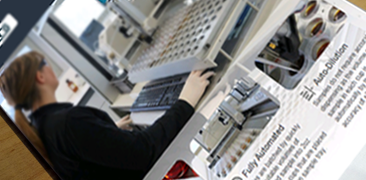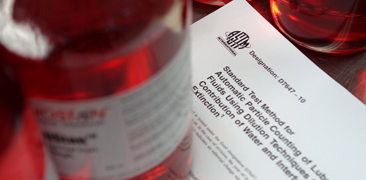
ASTM D7647-10 Ready
The system meets the requirements of ASTM D7647-10, in which oil samples are diluted prior to testing to eliminate interferences from “soft” particles.

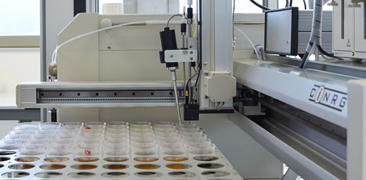
Auto-diluting particle counter for ASTM D7647-10 — superseded by the CS-APC-3
The original fully automated auto-dilution particle counter for ASTM D7647-10. Eliminates soft-particle interference from water, varnish, and suspended liquid additives, with a 104-position sample tray.
The system meets the requirements of ASTM D7647-10, in which oil samples are diluted prior to testing to eliminate interferences from “soft” particles.
Samples are batched by quickly pouring suitable volumes of homogenized oil into 2 oz (32 ml) sample cups placed in the 104-position sample tray.
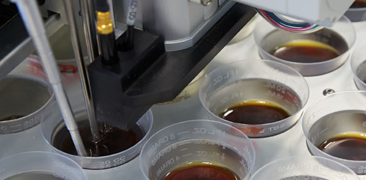
Samples don't require accurate dispensing — the system measures the volume in each cup automatically to an accuracy of ±2% prior to dilution.
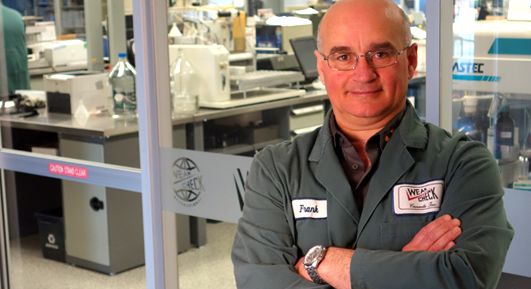
The CS-APC-2 is a fully automated system that meets the requirements of ASTM D7647-10. Oil samples are diluted with solvent prior to testing to eliminate interferences from “soft” particles such as water, varnish, and suspended liquid additives.
The system combines components from several leading equipment manufacturers with innovative technology and sophisticated software developed by WearCheck for use in their oil-analysis laboratory. The system has a high degree of flexibility and can be customized to suit local laboratory processing requirements.
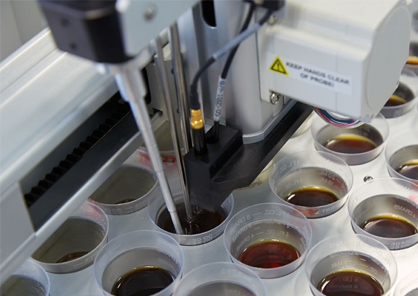
A batch of samples is prepared by pouring suitable volumes of homogenized oil into 2 oz (32 ml) sample cups placed in the 104-position sample tray. Samples don't have to be accurately dispensed — the system measures the volume in each cup to ±2% prior to dilution. Lab technicians control sample dilution by controlling how much oil is poured into the cup, since all samples are diluted to a final volume of 30 ml.
If higher accuracy than ±2% is desired, samples may be pipetted or weighed into the cups, and the sample volume (or weight and density) included in the system's batch file.
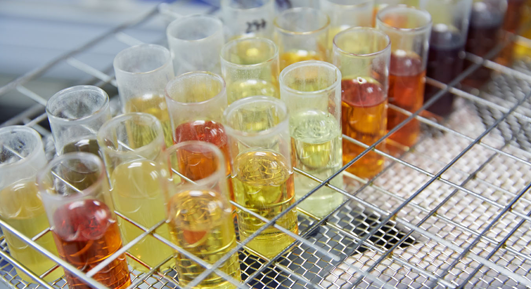
Samples are diluted prior to testing, and dilution ratios can be varied between 1:0 (no dilution) and 1:9 (one part oil, nine parts solvent). A 1:4 dilution, for example, is more than adequate for an oil sample with a viscosity of 1,000 cSt @ 40°C.
Samples can be processed without dilution if required, but viscosity should be ≤46 cSt for that workflow.
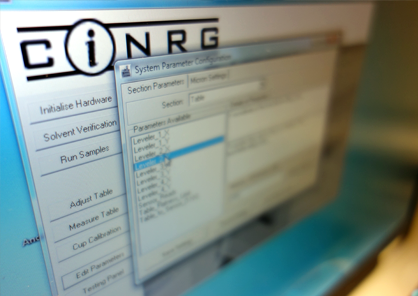
A batch file containing both sample information and processing parameters drives the application software. It can be created within the software or imported from CSV. Sample information includes ID, tray position, and optionally a sample volume or weight and density.
Processing parameters control how each sample is prepared: stir speed and duration, degas behavior, report format (ISO 4406 or AS4059). Parameters are typically 1–4, with the actual values defined in system parameters editable by the end user.
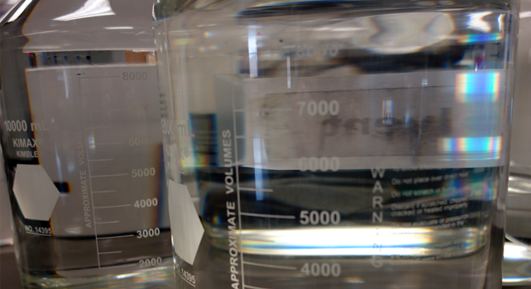
Before any testing, the cleanliness of the dilution-solvent batch is determined to obtain the count data later used to correct results for the effects of dilution. Solvent is loaded into position 1 (system flush) and position 2 (measurement). Several measurements are taken and validated against user-editable system parameters.
When sufficient data has been collected, average count values are calculated from valid measurements and stored as the solvent background counts for subsequent calculations.
| Sample throughput | 3.5 min/sample (6 hrs for a complete 102-sample tray)* 130–140 samples per 8-hour shift* |
| Solvent usage | 35 ml/sample** |
| Sample batch size | 102 samples (104-position tray; pos 1 = cleaning beaker, pos 2 = verification solvent) |
* Throughput rate is directly dependent on the settings of the processing parameters; specification stated is using default parameters.
** Solvent usage depends on dilution ratios and processing parameters; specification stated is for 1:1 dilution using default parameters.
| Model | KLOTZ LDS 45/50 Laser Sensor |
| Measuring range | 4µm to 70µm (3µm to 200µm oil calibration range) |
| 4µm co-incidence threshold | 25,000 particles/ml (undiluted sample) 50,000 particles/ml (1:1 dilution) |
| Cell dimensions | 450µm × 500µm |
| Flow rate | 10 to 50 ml/min (CS-APC-2 calibrated at 30 ml/min) |
| Model | KLOTZ USB Counter |
| Number of channels | 4,096 |
| Model | Baumer UNKC 09 |
| Accuracy | ±0.1 mm from 3 mm to 150 mm |
| Dimensions | 36″(W) × 30″(H) × 31″(D) (91 cm × 76 cm × 79 cm) |
| Weight | 85 lbs (39 kg) |
| Voltage requirement | 100–120–230/240 VAC selectable, 50/60 Hz |
| Input current | 6.0 A @ 100 V · 5.0 A @ 120 V · 2.6 A @ 230 V · 2.5 A @ 240 V |
Protected by patents US 9,164,019 · US 8,689,651 · CA 2,791,003 · CA 2,809,251 · UE 2,912,473. Other patents pending.
Common questions about the original CINRG auto-diluting particle counter, predecessor of the CS-APC-3.
Yes. The CS-APC-2 is fully supported — CINRG continues to provide service, parts, calibration fluids, software updates, and technical support to the field-deployed installed base. The CS-APC-2 has been superseded for new sales by the CS-APC-3, but operating instruments are not in any way obsolete.
Both meet ASTM D7647-10 with the same KLOTZ LDS 45/50 sensor, the same 4–70µm measuring range, and the same 104-position sample tray. They produce equivalent count data and use the same dilution methodology. The CS-APC-3 introduced refinements in robotics, software workflow, and the on-site calibration toolkit. For most practical purposes, an installed CS-APC-2 produces results identical to a CS-APC-3 on the same sample.
Yes. The CINSTAN line is common across all CINRG auto-diluting particle counters. The CS-CINSTAN-CFK Calibration Kit, CS-CINSTAN-PCS Process Control Standards, CS-CINSTAN-VF Verification Fluids, and CS-CINSTAN-SCF Super Clean Fluid all work identically on the CS-APC-2 and the CS-APC-3. The same NIST SRM 2806d traceability applies.
Some software-side improvements introduced with the CS-APC-3 are available as updates to existing CS-APC-2 installations. Hardware-level upgrades depend on the specific configuration of the customer instrument and require a service review. Contact CINRG to discuss specific upgrade paths for your unit.
Direct from CINRG or from your authorized regional dealer. Standard consumables — sample cups, KLOTZ sensor parts, syringe seals, tubing, calibration fluids — are kept in stock. Long-lead items can be quoted on request. Reach out via the contact form with your instrument serial number for a parts list specific to your configuration.
Yes. CS-APC-2 instruments are deployed in multiple ISO/IEC 17025 accredited laboratories worldwide and have supported method validation for ASTM D7647. Tekniker (Spain) reduced analysis and report times by close to 50% with the CS-APC-2 and used that improvement as the basis for accrediting D7647 under ISO 17025.
OelCheck Germany has processed more than 80,000 samples on a single CS-APC-2 instrument at approximately 5,000 samples per month, with reproducible counts and excellent dilution performance. WearCheck Canada used the CS-APC-2 to process heavily contaminated samples that conventional optical particle counters could not handle. These long-running deployments are part of why the CS-APC-3 retained the same KLOTZ sensor and dilution methodology.
Tell us about your throughput, your test methods, and your facility. A CINRG engineer will help you scope the right configuration — and put you in touch with your nearest dealer.